![[Translate to Englisch:] Antriebskomponenten für Papiermaschinen](/fileadmin/_processed_/e/e/csm_2026_Papiermaschinen_1873x700px_58bd18d435.webp "[Translate to Englisch:] Antriebskomponenten für Papiermaschinen")
Drive components for paper machines
Paper machines are used to manufacture paper, paperboard and cardboard. During this process, the material passes through various stages and sections. These include the wire section, where the actual sheet-forming process takes place, from the headbox right through to the optimisation of paper quality. This is followed by the press section, the drying section, the winding process and, finally, the cutting section. At the various stages, couplings must meet different technical requirements.
Web tension control in the manufacture of speciality papers
In plants for the manufacture of speciality papers, the raw material is transported to the individual processing stations via a continuous drawing process. The end product resulting from these processes is ultimately an extremely tear-resistant composite material. During this process, the webs pass through various stations with a wide range of environmental and media conditions. The sensitive web tension control is handled by the pneumatically adjustable slip hub from the Securmax Slip series, equipped with precisely matched friction linings. The slip torque on these slip hubs is adjusted with precision via the compressed air setting. Depending on the compressed air setting, the torque can be adjusted between 3 and 875 Nm. To suit the prevailing environmental and media conditions, the slip hub features a high-quality surface coating in the form of a chemical nickel plating.
High torque requirements in fully automatic bagging systems
Fully automatic bagging systems ensure highly efficient and precise filling with exact repeatability and without compromising product quality. A wide variety of production stages are involved here – from the filling process through to the sealing of valve, cross-bottom or side-gusseted bags and the final palletising process. The Torqmax rigid coupling proves to be the ideally suited partner in such bagging systems for the high torque requirements of the systems and for the precise transmission of drive power. The rigid shaft coupling features key quality characteristics. Honed bores in the version with full-length shaft diameters ensure the highest surface quality and meet requirements regarding dimensional tolerance and dimensional accuracy. In addition, most of the couplings feature a special screw lock, which ensures that the high-quality hexagon socket screws used retain their clamping force permanently, even in the event of vibrations, thereby enabling the rigid coupling to transmit torque reliably and safely over the long term. If an installation-friendly and time-saving design is required for a particular system, the two-piece shell coupling ensures radial mountability.
For bagging systems used to fill food packaging with specific hygiene requirements, the Torqmax rigid coupling is available in one-piece and two-piece versions made of stainless steel. The StepBore variant is the solution for systems with different shaft diameters in the drive train.
High-speed paper cutting systems
In the final stage of paper production, the products are cut to specific sizes. This is done using paper cutting systems, such as three-knife trimmers or cross-cutters. For example, after a printing run, sheets are cut according to layout specifications before being fed into the folding machine. After folding and binding, a final trim to the end format must also be carried out. In addition to precision with minimal dimensional tolerance, speed, throughput and flexibility also play a decisive role in the cutting process. Automatic roll and tool change systems ensure time-saving changeovers of these systems to a wide variety of roll widths and material thicknesses.
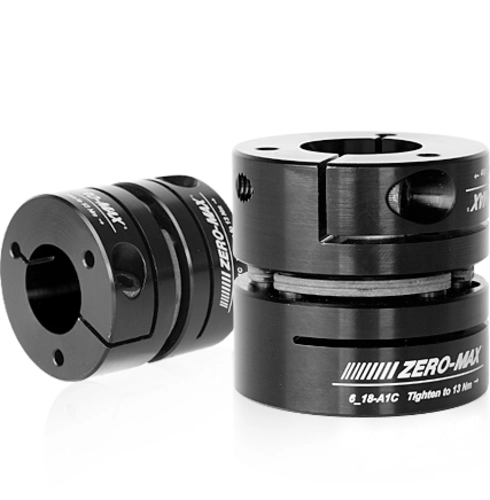
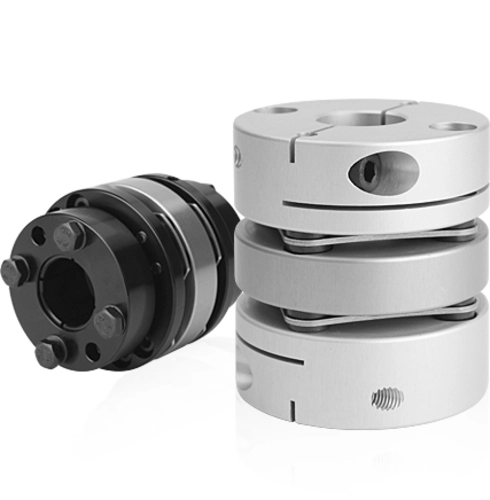
The Diskflex servo-disk coupling and the CD A1C coupling offer characteristics precisely tailored to these requirements. They are torsionally rigid, have minimised mass inertia and are designed for high speeds.